Fig. 1: Cover of Alexander's rug book: brown letters on transparent plastic dust jacket over patterned cloth binding. Weird, more pleasant to handle without plastic dust jacket.
Fig. 1: Cover of Alexander's rug book: brown letters on transparent plastic dust jacket over patterned cloth binding. Weird, more pleasant to handle without plastic dust jacket.
Note: Italics in quotations are not my italics, but original italics in the text.
Christopher Alexander's much frowned-upon rug book deserves a chapter on its own. I am not interested in judging whether its ideas are right or wrong—I am not interested in attacking Alexander's theory or argue about fine points. What counts for me is whether the system of ideas exposed in this book proves applicable and fruitful in analysing and appreciating rugs.
The book presents an approach to rugs which is decidedly a-historic. Alexander does not consider technicalities of weaving or the 'use value' and 'exchange value' of rugs, i.e., the social and economic context of their production. He is also neutral regarding discussions of design origins, i.e., the various theories regarding the migration and development of patterns (as coarser 'degenerate' renderings of court and manufactured rugs; as import from Chinese designs passing through central Asia on the silk road; as offspring of archaic tribal totemic symbology; or as a repertoire brought about and constrained by technical characteristics of the weaving technique)—all theories that have been argued about in many other rug books.
Technicalities count only inasmuch as Alexander emphasises the knot—roughly 1/8 inch x 1/8 inch—as the smallest visual design element. These elements then make up the 2-dimensional plane on which color and geometry alone produce the impact of the rug (Alexander refers to 'carpets', I see myself slipping back to 'rug'). In other words, the texture and handle are not really part of the discussion: 'There is really nothing else: just the geometry and the color of the plane' (p15).

Fig. 2: Intense colour in the Yellow and blue carpet with griffin and archaic border. (Picture quotation: Alexander, A Foreshadowing.., p16)
Let me first list a few central tenets of Alexaner's carpet book:
Alexander maintains that the quality of wholeness or oneness, the god-like quality of a carpet is 'not merely a matter of preference or taste for different observers, but instead a definite, tangible, and objective quality, which really does exist to a greater or lesser degree in a carpet' (p26). This hinges on a carpet's 'structure of centres', qualitative phenomena which Alexander maintains can be recognised objectively, based on sufficient experience. He likens this experience to the situation of a geologist who, based on experience, can glimpse the possibility of oil being contained within a certain rock formation.
As one empirical way to get past the overlay of preferences to an objective assessment of the quality of a carpet, Alexander proposes a peculiar method: '(..) we must construct a question which is so concrete that it shocks the system, and forces more direct, more true, and more accurate response' (p28). 'The question asks: "If you had to choose one of these two carpets, as a picture of your own self, then which one of the two carpets would you choose?"' (p28). (...) 'In case you find it hard to ask the question, let me clarify by asking you to choose the one which seems better able to represent your whole being, the essence of yourself, good and bad, all that is human in you' (p29). I include a scan of the illustration of the two carpets as image quotation.
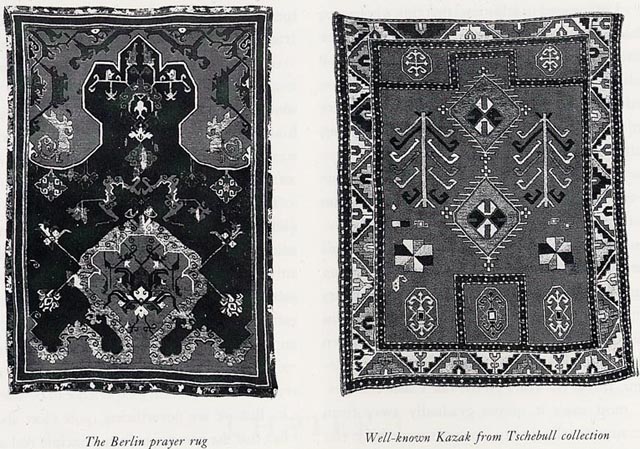
Fig. 3: The question to determine objective wholeness: 'Which of these two carpets would you choose as picture of your own self?' (Picture quotation: Alexander, A Foreshadowing.., p28)
According to Alexander, most people faced with this question choose the Berlin prayer rug over the Kazak. 'This happens essentially because the question focuses awareness on the real oneness of the person, and compares it with the oneness of the carpet. The carpet with greater oneness seems more like "me" because I am comparing it against my own oneness' (p29). Alexander contends that this feeling of greater depth 'is an objective judgement—not a subjective preference—and that it arises because indeed, the left-hand carpet has a deeper and more significant structure' (p30).
An different and quite mundane explanation for people's preference for the Berlin prayer rug would point out that its dominant shape resembles the human outline from the shoulders upwards, making it immediately an easier target for identification. That the same shape is repeated twice would aditionally suggest various mappings (e.g. the idea of split roles or realms of a person, the idea that the 'shape' of a person is defined by his or her context, background or role models, and so on).
The structural analysis first focuses on centres: 'a "center" may be defined as a psychological entity which is perceived as a whole, and which creates the feeling of a centre, in the visual field.' These are, for example, blossoms in frontal and side view, stars, niches with double hook accents, or arrowheads. Alexander then proposes that these centres organise smaller centres. Alexander compares rugs, counting centres, in order to objectify his assertion that those rugs which have more centres (despite being not necessarily more complex) achieve a higher degree of integration. In some cases I would not identify an 'atomic' centre where he counts one, e.g., to prove his point that the Seljuk rug (the left image of fig. 4) has the most centres.
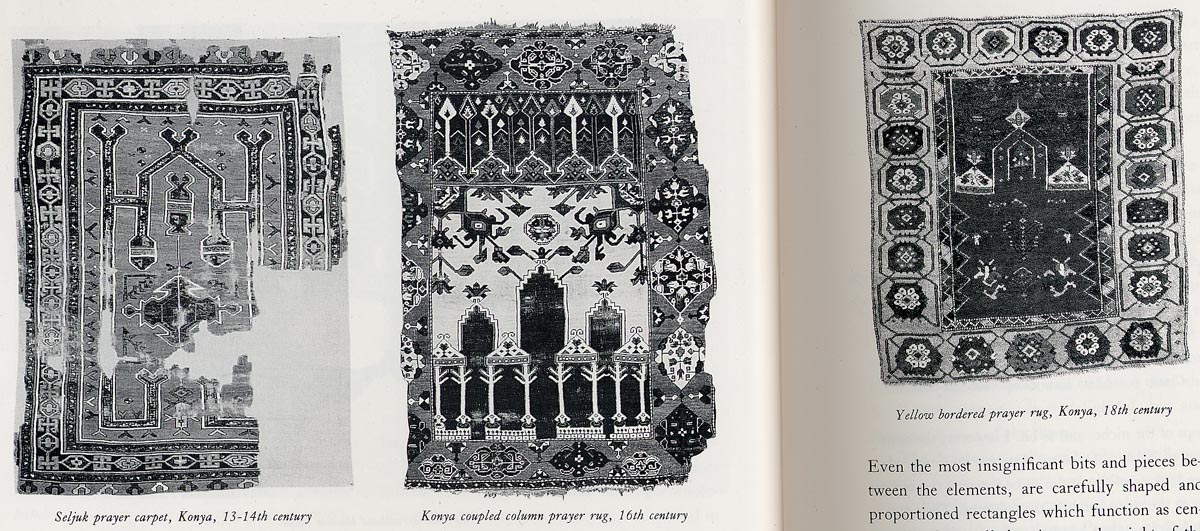
Fig. 4: Multiplicity of centres: comparison by counting centres of three rugs. Click on image for a larger view. (Picture quotation: Alexander, A Foreshadowing.., p38-39)
When closely looking at the three carpets that Alexander presents to show that the oldest—a Seljuk prayer carpet, Konya, from the 13th–14th c.—has more centres than a Konja coupled column prayer rug and that both surpass a Yellow bordered Konya prayer rug from the 18th century, I agree with the overall judgement, but would arrive at it using a different approach. One element of that would be what might be called the 'structural statics', another the efficiency of organising figure and ground of the rug, i.e. the distribution of well measured 'strokes' that create 'the shape that carries' and at the same time, the ground. This seems not necessarily linked with the number of centres but more with the proportions and directions of elements as they link up to form a two-dimensional archiecture. In the Seljuk rug, the structure of beams looks very sound, even though the central mihrab arch is suspended on horizontal links to the two side beams. In the Yellow-bordered prayer rug, for example, the mihrab hovers in thin air above the field, which itself is adorned with non-structural elements. In the 16th c. coupled columns prayer rug, the array of arrow-shapes of the upper parapet seems to weigh down on the light field, from which it is separated by a thin horizontal (non-supporting) line. You can nearly see the line giving way under the weight of the parapet's elements. While strucural statics are strictly unnecessary in a two-dimensional horizontal object with no supporting function (except for the soundness of weave and pile) I feel that I import expectations of structural soundness into the design which have been formed during childhood, when tinkering with wood and other materials and making discoveries about the soundness (and failure) of structure.
The structural soundness and efficiency of the Seljuk border is even more evident, compared to the heavy cartouches of the coupled column prayer rug which swim on the background, and thin scaffolding around the octagons of the yellow-bordered prayer rug with its unsuccessful corner turn (I guess this was the top of the rug when it was woven).
Another concept which is not identical to centres is that of structural echoes that integrate the design. In discussing the Seljuk prayer rug, Alexander includes these under centres, remarking that 'the reflections and echoes of one shape in another create further invisible centres, by making invisible cross-link lines, that connect similar but not identical components to one another' (p40). Including invisible centres seems not so helpful to me, these may proliferate with no end, the exact opposite of the 'countable centres' at the outset of the analysis. Instead, what creates the strength and integration here seems to be the reduction of the design repertoire to a small number of basic elements (the T-shape, the related Y-shape). It might then be the smaller count of basic design elements rather than the larger count of centres that would explain greater oneness (integration).
(An aside: I do not wish to suggest that 'higher integration' or 'reduced repertoire' are timeless qualities characterising good or great art, or even art alone; here, I simply suggest a different analysis within a particular paradigm of art where quality judgements are based on the (partly measurable) degree of aesthetic perfection—Vollkommenheit—within a well defined repertoire of expression.)
Alexander then shows the role of local symmetries in integrating design motives and creating centres; some symmetries are axial (one or more axes), some point-symmetric (called rotational symmetry in the book ). Beyond local symmetries within a motive (or centre) it is also symmetries across the visual plane, relating distant but symmetrical centres, which tie the design together. Alexander goes on to show that even floral designs are governed by these local symmetries. Based on an experiment conducted together with Bill Huggins at Harvard University in the early 1960's which investigated the role of symmetries in perceiving coherence, he summarises that 'the most coherent patterns are the ones which contain the largest number of local symmetries or "subsymmetries"' (p49)
Applied to the analysis of carpet design, Alexander proposes that 'the more local symmetries a center contains, the better it is as a center' (p49). Which would mean that a rosette is a better centre than a boteh or a palmette (flower in profile). The same notion he applies to the carpet as a whole, obtaining the following formulation: 'Every carpet is, at one and the same time, a system of centers, and itself a center. Its goodness depends on the number of centers it contains, and on the number of local symmetries which each of the center is made of' (p49). And further: 'There is a curious bootstrap effect, an almost circular proposition, at the basis of the phenomenon which we are studying. Centers are made up of other centers. A center is an organization (or field) of other centers. It achieves its significance to the degree that each of these other centers which it is made of, is itself significant. And an entire carpet, being merely yet another center in the endless hierarchy of centers, also achieves its significance to the degree that it, itself, is also made of other centers which are significant' (p49).
The paradox of this concept of significance is that at bottom, its fundamental 'atomic' elements are no more signficant than 1-0-1 or 0-1-0 or even 1-1 and 0-0 (the smallest axial symmetry). If significance is taken literally, it means that it signals something against a dicernable background; that it stands out as 'information' against the redundancy of likeness, repetition, noise. This competing concept of significance is of course related to Shannon's mathematical information theory which was motivated by the need to secure the maximum compression and safe transmission of messages across communication channels which might introduce noise or distortion. I am not going to delve in this any further; the aesthetic reverberations have been expored extensively in a book by Kurd Alsleben, "Aesthetische Redundanz" (in German; with luck you still find it second-hand). In this contrasting view, the significance of design elements would result in a dialectic relationship between redundant elements and disruptive elements (e.g., asymmetries introduced into symmetries).
On another level, significance resulting from pattern coherence can be opposed to significance as the act of a signifying marking. In the latter case, it might be the reduction of centres and the dominance of space-grabbing primary marks that create greater coherence. Looking back at the three prayer rugs compared in figure 4, would not the simpler and more dominant (literally remarkable) shape of the Seljuk rug explain its assumed superiority equally well?
Alexander's concept of positive space in carpets echoes the pattern 106 Positive outdoor space in his book A pattern language, where he suggests that indoor and outdoor space are mutually constitutive and that the shape of buildings (or clusters of buildings) should enclose positive spaces that are well defined. This leads, for example, to a verdict on round buildings since they usually have unsatisfactory (concave) outdoor space.
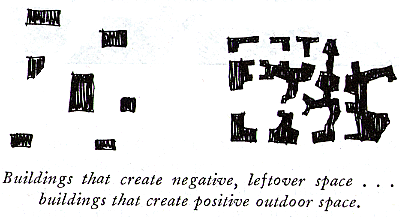
Fig. 5: A diagram comparing the way buildings create negative space and positive outdoor space. (Picture quotation: Alexander, A Pattern Language, p518)
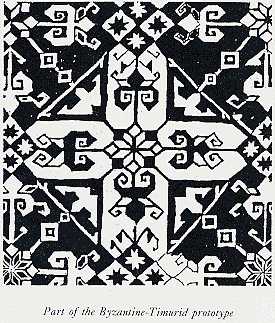
Fig. 6: Byzantine-Timurid prototype showing 4 foreground spade motifs around the centre, and larger diagonal white 'virtual' spades in between. (Picture quotation: Alexander, A Foreshadowing.., p56)
Applied to carpet design, positive space simply means that in the opposition of figure and ground, the ground should as much as possible be well-formed (i.e. constituting centres with local symmetries). In some cases of textile production, as in warp-faced straps, technique mandates, for reasons of equal warp tension, that figure and ground become equivalent in terms of space and interlocking.
In the chapter on Levels of Scale, Alexander goes on to show how centres integrate smaller centers, from the 'atoms' up to the whole carpet. He posits that 'A centre will become distinct, and strong, only when it contains, within itself another centre, also strong, and no less than about half its own size.' (p59)
The chaper on differentiation then talks about the way a shape is worked out. Alexander does this by picking a simple cross shape, rendered in a quick-and-loose style of drawing, and shows how it is made more complex by adding more centres and symmetries and more distinct shaping of the boundaries which at the same time create a strong space in between the eight lobes of the motif. The end result is the star Ushak form (fig. 7; his final drawing is the left image).
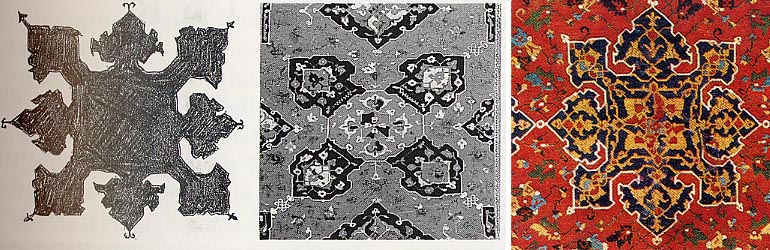
Fig. 7: Star Ushak form, end result of hand-drawn differentiation. (Picture quotation left and centre image: Alexander, A Foreshadowing.., p65; Picture quotation right image: Islamic Carpets from the collection of Joseph V. McMullan, p47/plate XXIII)
Whether this kind of progressive differentiation is analogous to what happened, spread over a long period, when designs such as the Ushak octofoil medallions emerged, is another issue. Looking at early examples in tiles of the Masjid-i Kabud mosque ('blue mosque') in Tabriz completed around 1465 (compare fig. 8) that Walter Denny considers important design precursors for the star Ushak, the particular form of the lobe seems to describe an outline around a central palmette flower and secondary arabesques drawn around it (left side of fig. 8), defining a characteristic curvy fishlike form between the lobes that seems to have lost its elegance in later versions such as the one shown on the right image of fig. 7.
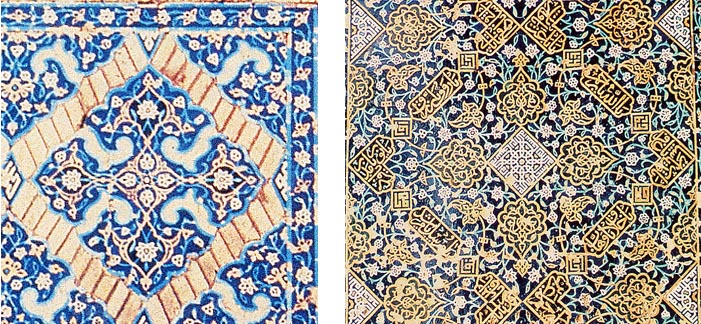
Fig. 8: Two tile patterns, possibly precursors of the star Ushak design, in the Masjid-i Kabud mosque in Tabriz. (Picture quotation (modified): Denny, The classical tradition in Anatolian Carpets, p40–41)
Notice also that in the tile precursor (left image of fig. 8), we find a strong preference for foreground shapes, the background showing little internal differentiation. So what has changed in the transition to the star Ushak form shown in fig. 7 (right side)? In the latter, there is evidence of two design layers, both treated as foreground, which interweave. The catalogue text to the McMullan exhibition describes it thus: 'Closer examination reveals, however, an exceedingly fine trellis that connnects all floral elements into a continuous, secondary pattern covering the entire field' (p47). I can discern no direct attention to shaping the background beyond rules of even coverage by the trellis that avoids large empty spaces, but equally avoids close proximity. The organic / architectural nature of the arabesque or trellis interleaves holding together the design (much more successful in the second tile example in figure 8) seems hardly accounted for in Alexander's centric approach. His description seems much better suited for the geometric design tradition, with fitting examples in (images of) Seljuk carpets and later geometric designs where foreground and background can verge towards the interchangeable.
A further digression: Looking at the right side of fig. 8, it even seems possible that the second set of four lobes grew out of the smaller palmettes that are here end points of curling arabsques falling into place between the more dominant lobed quatrefoil flowers. In any case, the proportions seem more elegant than in the octofoil version where the two types of lobes are of nearly equal size (but not quite).
These digressions have led away from the Alexander book. But they show that historic or figurative approaches indicate other connections and roots of design choices that leave the immanent and formal level that Alexander aims at. (A final aside: I have to admit that I have never been particularly drawn to the Star Ushak form, which to me seems somehow over-elaborate and suffers from the closeness of the 'main' and the secondary lobes.
A summing-up of the characteristics of centres leads to the statement of a complex circularity in which'the existence of a center always seems to hinge on the exisitence of other centers' which in turn depend on yet other centres.
'Somehow, we have to find a composition which is composed entirely of centers, filled with centers—and further more, this almost infinite array of centers, must all be strong ones—sharp, distinct, surrounded by positive space, and themselves bounded by other equally beautiful centers, and likewise made up of them'(p67)
Alexander then illustrates how hard it is to do by the number of mathematical possibilities even within a very limited choice space of an array off 11 x 15, arriving at 1047 possible combinations.

Fig. 9: Two versions of an 11x15 array of 69 black and 96 white blocks: a random one and a Seljuk pattern (p68)
The Seljuk pattern we will revisit in the repeat pattern guls in one of Alexander's rugs described in the second half of the book: a 16th century Konya rug. The effort to demonstrate how hard it is to come by such a pattern by pointing out the number of arithmetic operations needed to compare all possible shapes for the one with the highest number of subsymmetries and and in turn, the time this would take (1036 years, in case you wondered) seems a bit tedious and besides the point. The brain does not work like a computer; and while I am not a computer scientist, I bet that a modern pattern analysis algorithm would come up with the answer to such a small-scale problem in less time than it takes to fix a cup of tea.
The insistence that 'no matter what method is used, it is sheer hard work that is needed to find the highly dense and beautiful figures' strikes me as odd. Patterns have evolved over a long time, so the image of the individual weaver who tries hard to come up with a convincing pattern looks like an exception to the rule of copying, adaptation and slight modification of the traditional designs reported in field studies. Alexander then repeatedly praises the 'juggling problem' in the creation of a center in superlative terms: 'It is a real achievement, like building the Great Wall of China. Certainly it does not come lightly.' As the reason for the dificulty of creating an overall coherent design he points to the repercussions of each modification in surrounding and enclosed patterns: 'This the work of creating this kind of coherence—is an immense, and almost endless task—extremely difficult, demanding—and yet thoroughly specific.'
This way of describing the design task as a complex and recursive juggling and tweaking of elements is fitting for a draughtsman in a royal carpet workshop, less so for the rural production of Anatolia on which Alexander mostly draws to exemplify his theory. We know that many of the designs used in the geometric village rugs were descendants of earlier curvilinear court carpet designs. It is easy to imagine that during the design of a complex pattern, a lot of careful finetuning (on paper) took place. In the context of production of Alexander's rural examples, it is more likely that most rugs had an older sibling that acted as blueprint, at least for parts of it. This should not be seen as a belittlement of the achievement of the weaver. What we know about the nature at least of rural carpet production just seems quite different from the exceptional creative task that Alexander posits. And with manufactured carpets, the re-use of the same cartoon for multiple copies of the same rug (perhaps with variatons) is the main point that makes production more efficient. In that context, the creative achievement would mostly be one of the original draughtsman (or book illustrator), not so much one of the weaver who meticulously translates the cartoon into woolen structure.
With that in mind, it is strange to see how Alexander links his extraordinary creative task of juggling and fine-tuning of centers to the actual rural production process. This he achieves by lifting the hard work he has described to another plane, to 'a more spontaneous frame of mind':
'Under these circumstances the design is not thought out, conceived—it springs to exisitence, almost more spontaneously, during the process by which it is made.
And of course, this process corresponds more closely to the conditions under which a carpet is actually woven—since working, row by row, knot by knot; and having to create the design as it goes along, without ever seeing the whole, until the carpet itself is actually finished—this condition, which wouldseem to place such constraint and difficulty on th eact of creation—is in fact just that circumstance in which the spontaneous, unconscious knowledge of the maker ist most easily released from the domination of thought—and thus allows itself most easily to create the deepest centers of all.' (p72-73)
Holy mystification! This is what I call a real stunt: from the meticulous and incredibly hard labour of center design to a spontaneous and unconscious act of creation in a few transmogrifying phrases. I accept that long practice in rug-weaving will lead to a point where certain patterns (especially repeat patterns) will flow quickly and become lively by the seemingly random changes in color or the variation in dyes (abrash). But in most other cases I imagine that the weaver will not work in an elevated dream state but pay close attention and apply thought and planning to the correct implementation of a respective pattern or combination thereof (looking at the back of another rug, a drawing or perhaps a sampler). The linear nature of the task and the fact that mistakes cannot be corrected do place a significant burden on execution, and we know of numerous rugs where it shows that something went wrong (often not to the detriment of the result). However, if you know better or think otherwise, please tell me and I am happy to include your comments here.
Alexander tells us that the full evidence which leads him to this statement is detailed rather thoroughly in his 4 volume work The Nature of Order. I value Alexander's work (especially his book Pattern Language), but I find it hard to stomach mystifications that seem to run counter to everything else I have read about the social context of production of rugs.
(to be continued)